The Wrong Victim
Alecia Wheeler repeatedly sought protection from a violent husband. Gregory Slate was surrounded by stalking complaints, criminal cases, fraud allegations and warnings about his credibility. Yet D.C.'s domestic-violence machinery devoted extraordinary attention to Slate's accusations while Wheeler went into court without the government lawyer she needed.
Life Sentence on the Internet: The Gregory Slate Investigation
Watch the full investigative video, then continue below for the documents, recordings, court filings and other primary-source evidence behind the story.
Author's Note
This article is investigative commentary written by Diop Kamau. It reflects my reporting, conclusions, opinions and firsthand account of events in which I and my wife were involved. Source documents, recordings, court filings and other primary materials are presented throughout so readers can examine the record for themselves.
Alecia Wheeler Was the Victim the System Was Built For
On September 13, 2011, Alecia Paulette Wheeler was stabbed to death in the 1200 block of Neal Street NE in Washington, D.C. The Metropolitan Police Department recorded her death as a homicide.
Wheeler's death did not begin in that alley. She had been telling the District that she was in danger. Her estranged husband, Claude Kinney, had beaten her, threatened her with a knife and threatened to cut her throat. Wheeler did what endangered women are told to do: she sought help, entered the domestic-violence system and went to court.
She did not receive an Assistant Attorney General standing beside her when she sought long-term protection. She returned again for protection. The next day, Kinney attacked her in front of her four children and killed her.

Alecia Wheeler Asked the Court for Protection. A Day After Her Final Petition, She Was Killed.
The Washington Post reported that Alecia Wheeler filed at least two court complaints describing repeated domestic assaults and threats. On August 12, 2011, she sought a year-long protective order. The court granted temporary protection, but at an August 29 hearing declined to issue the year-long order. Wheeler returned to Superior Court in September and filed again. Police said that the next day Claude Kinney fatally stabbed her while she was walking with her four children, ages 1 to 9.
The Post article does not discuss Gregory Slate, Sarah Connell or Janese Bechtol. The comparison on this page is our investigative one: while Wheeler was repeatedly seeking protection from a man accused of threatening to kill her, the same D.C. domestic-violence system was devoting government resources to Slate's allegations against Tyra Ferrell.
A Real Domestic-Violence Emergency. A Celebrity Case.
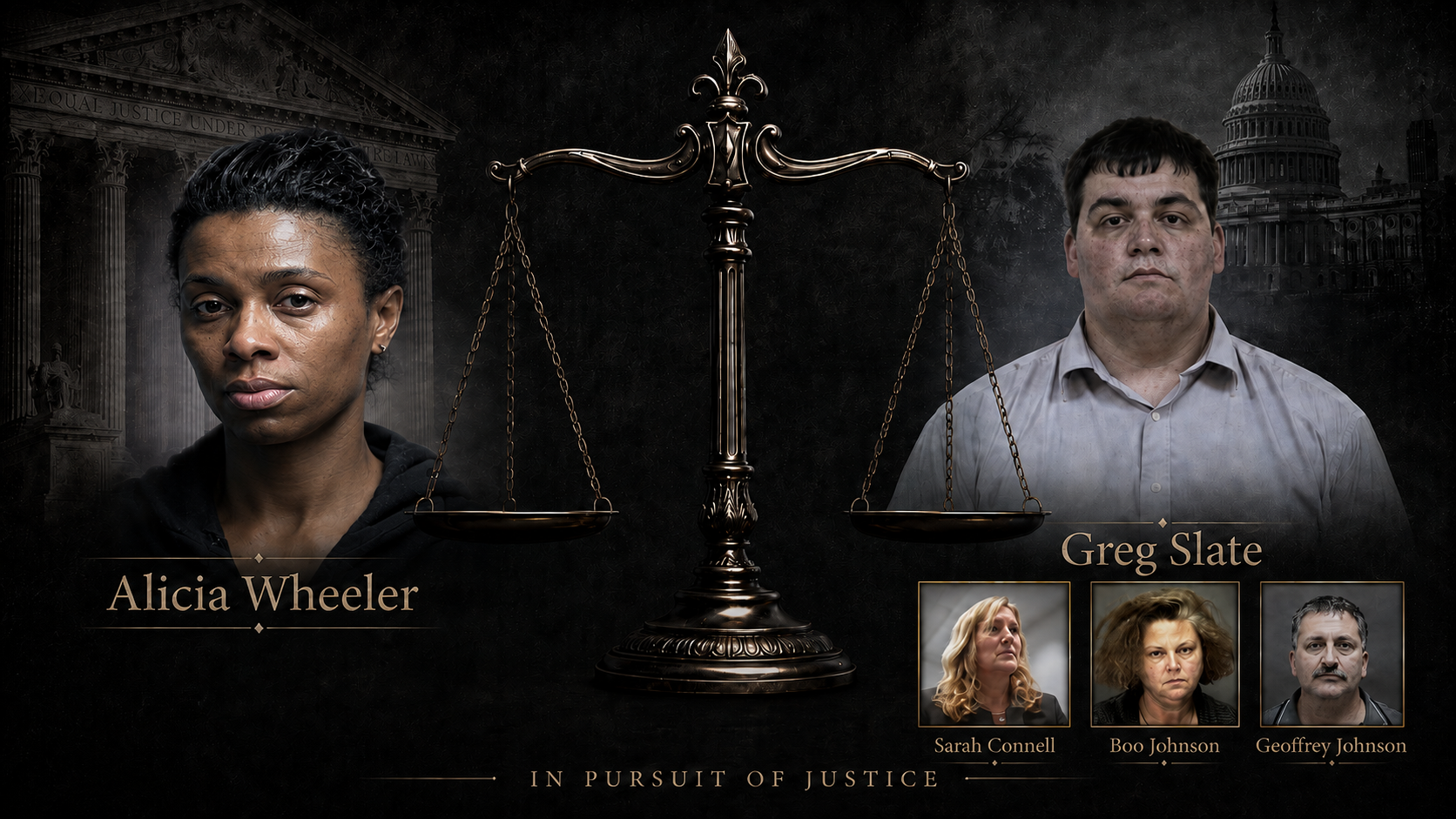
At the same time Wheeler needed protection, Assistant Attorneys General Sarah Connell and Janese Bechtol were devoting government authority to a case built around Gregory Slate's accusations against actress Tyra Ferrell. Ferrell's celebrity made the matter conspicuous. Slate's allegations produced hearings, filings, orders and sustained prosecutorial attention.
Wheeler's terror was ordinary. Slate's controversy was interesting. Government offices reveal their priorities not through slogans but through where they put lawyers, time and power.
They Were Warned
The prosecutors were not operating in an information vacuum. Warnings about Slate reached D.C. officials repeatedly. In early 2011, OAG investigative leadership was told that Slate had a history involving fraud allegations, restraining orders and stalking complaints.
On August 30, 2011, a detailed complaint addressed to Attorney General Irvin Nathan challenged the Domestic Violence Section's reliance on Slate and warned that government resources were being used on a fraudulent case while genuine domestic-violence victims needed help.
The complaint circulated inside the Attorney General's office. Gail Stern routed it to prosecutors including Connell and Bechtol. The warning also reached the Metropolitan Police Department's domestic-violence coordinator.
The Man Prosecutors Chose to Believe
I describe Gregory Slate as a serial stalker because the record does not describe one isolated dispute. It describes repeated complaints from unrelated people, protective-order proceedings, police involvement and recurring allegations of unwanted contact, surveillance, intimidation and harassment.
Slate was also accumulating arrests, probation problems and allegations of evidence fabrication and fraud. His arrest, probation and litigation history belongs in the same public record as the cases in which government officials chose to rely upon him.
Gregory Slate and the Police Complaint Center
The record of Slate's relationship with the Police Complaint Center matters because he later tried to distance himself from it. The contemporaneous documents say something very different.
Slate Calls Himself PCC's Executive Director
In a November 9, 2007 letter concerning an undercover investigation at Prince George's County FOP Lodge 89, Slate wrote that he was acting as the Executive Director of the Police Complaint Center and also described himself as its director of investigators. He described the undercover operation, the equipment used, the alleged assault on him, and his attempts to report misconduct.
Read Slate's Prince George's County LetterUnder Oath, Slate Says He Does Not Know What PCC Is
During his February 25, 2011 deposition in the ABC case, Slate was asked whether he knew what the Police Complaint Center was. He answered no. Asked whether he had ever identified himself as working with the Police Complaint Center, he said he did not recall.
Read Slate's ABC DepositionThe Recording and the Letter Tell the Same Story
The Prince George's County episode gives us something unusually strong: a contemporaneous recording of Gregory Slate speaking directly with county police, followed by Slate's own written complaint about the same incident.
In this short evidentiary clip, Slate tells the responding officer, "I have my supervisor on the phone." He then explains why he was at the FOP event, describes his hidden-camera equipment, and identifies himself as working for the Police Complaint Center in Washington, D.C.
That spoken identification matters because Slate later put essentially the same employment claim in writing: his Prince George's County letter identifies him as PCC's Executive Director and Director of Investigators. The audio and the letter are therefore not separate anecdotes; they are two contemporaneous pieces of the same employment record.
This short evidentiary clip contains the relevant exchange only: Slate asks the officer to speak with his supervisor, identifies himself as working for the Police Complaint Center in Washington, D.C., and explains the hidden-camera investigation.
Why the Contrast Matters
In 2007 Slate affirmatively represented himself as PCC's executive director. In 2011, under oath, he claimed not to know what the Police Complaint Center was and said he did not recall ever identifying himself as working with it. That contradiction belongs at the center of the credibility story.
Kamau's 2008 Letter to Slate's Father
This contemporaneous letter records my account of terminating Slate from PCC, ending his duties, disabling company accounts and demanding the return of property. It also documents that Slate had earlier been appointed to a director position and trained in undercover and hidden-camera work.
Read the Redacted March 26, 2008 Letter to Clinton SlateABC / PCC Work Records
Additional contemporaneous emails show Slate negotiating investigative terms with ABC personnel, discussing PCC investigations, media projects, hidden-camera work and PCC assignments.
View PCC / ABC RecordsThe Employment Record Slate Tried to Erase
The strongest evidence that Gregory Slate worked for the Police Complaint Center does not come from me. It comes from Slate's own words, Slate's own email signatures, Slate's own resignation language, recordings of Slate introducing himself, television reports made while he was doing PCC investigations, ABC's business records, travel records, expense records, mail records and the documents Slate himself produced in litigation.
ABC's 42-Page Record
In its September 2, 2011 summary-judgment memorandum, ABC told the federal court that hundreds of contemporaneous documents and recordings showed that ABC contracted with the Police Complaint Center and that Slate interacted with ABC as a PCC principal and employee—not as an independent freelancer. ABC's filing describes Slate as helping form the deal, negotiating with producers, traveling on ABC's dime, using PCC email and mailing addresses, taking direction from Diop Kamau, turning over footage, seeking reimbursements and repeatedly calling himself PCC's Director.
ABC's point was devastatingly simple: the documentary record created while the work was actually happening looked nothing like the story Slate later told in court.
The Public Record Called Him PCC's Director
ABC cited a California appellate opinion identifying Slate as working for PCC in Washington, D.C.; KCTV footage describing him as an undercover tester from PCC; a Miami CBS report involving a PCC operative; and a St. Louis KTVI investigation in which Slate appeared on camera while the story identified him as Director of the Police Complaint Center.
ABC also cited a September 2007 St. Louis Post-Dispatch article identifying Slate as director of the nonprofit Police Complaint Center.
"Gregory A. Slate, Director, Police Complaint Center"
During negotiations for the 2007 ABC investigation, Slate communicated directly with producer Glenn Ruppel using a signature block identifying himself as Gregory A. Slate, Director, Police Complaint Center and listing PCC's 1220 L Street Washington address.
ABC's filing says Slate participated in both forming and carrying out the agreement and repeatedly spoke in terms of "we," "us" and "our organization."
Executive Director and Director of Investigators
The Prince George's County evidence above now lets readers hear and read the contradiction for themselves. Slate tells police he has his supervisor on the phone and identifies himself as working for the Police Complaint Center in Washington, D.C. His written complaint concerning the same episode identifies him as PCC's Executive Director and Director of Investigators.
Hear the PG County RecordingSlate Introduces Himself as PCC's Executive Director
In a preserved call to Mothers Against Drunk Driving, Slate tells Caroline Cash that he is the executive director of the Police Complaint Center in Washington, D.C. He then describes PCC's hidden-camera investigations of police misconduct and says the organization works with national television programs.
This is not somebody else giving Slate a title. It is Slate introducing himself in his own voice.
The 1220 L Street problem: Slate later professed not to know what the PCC's Washington mailing address was or whether he had ever used it.
ABC's filing says the mailbox records included an application for "Greg Slate, Police Complaint Center"; that Slate used 1220 L Street in ABC correspondence, lawsuits and property-related transactions; that ABC sent payments and equipment there; and that Slate referred to the location as PCC's "mailroom" while the project was underway.
Money, Travel, Cameras and Supervision
ABC's filing says ABC paid PCC fees, paid thousands of dollars in Slate's airfare, hotels, rental cars and incidental expenses, shipped camera equipment to him, and communicated with both Slate and Kamau as PCC principals.
Phone records cited by ABC showed 39 outgoing calls from Slate to Kamau during the final week of the first Chicago trip, and 198 outgoing calls during the first three weeks of September while the next phase of the project was being arranged. ABC used those records as part of its argument that Slate was working under Kamau's supervision.
You Cannot Resign From a Job You Never Had
As the PCC relationship collapsed in late 2007, ABC's filing quotes Slate worrying that he was being "fired", complaining that he had delayed law school to work on the DUI investigation, and then sending an email titled "Resignation" stating that he could no longer continue in his "capacity at the Police Complaint Center."
ABC also quoted Slate later asking Kamau and the PCC board for a letter acknowledging that he had been a "good employee."
He Asked PCC to Say He Had Been a “Good Employee”
After the relationship broke down, Slate sent Diop Kamau an email asking for a letter from the PCC board and Kamau acknowledging that he had “conducted [himself] with integrity, been a good employee, and [had] not done anything untoward, inappropriate or unethical.” The email is especially important because it was written before the later litigation position distancing Slate from PCC, and because the surrounding message discusses Tyra Ferrell and the breakdown in the relationship.
The two-page Exhibit S167 below preserves the exhibit cover and the actual December 14, 2007 email. Readers can scroll it here or open the PDF separately.
Then the Story Changed
Once the ABC dispute turned into litigation, Slate's memory of PCC began to disappear. In his February 25, 2011 deposition he said he could not recall being PCC's Director, could not recall using gslate@policeabuse.org, could not recall sending or receiving PCC email, and professed uncertainty about 1220 L Street.
ABC's memorandum described the litigation strategy as an attempt to manufacture a record that effectively erased PCC from Slate's memory and history. The filing pointed to the contemporaneous documents as the answer to that effort.
Under Oath: "No."
At a D.C. Superior Court hearing, Tyra Ferrell asked Slate directly whether he had ever worked for the Police Complaint Center or PoliceAbuse.com. Slate answered: "No."
When asked what he did for a living, Slate answered that he was a landlord. When Ferrell confronted him with the existence of video showing him performing PCC investigations and being identified as Director, Slate again denied remembering the work.
The transcript also records the court stating that it would be unethical for lawyers knowingly to elicit testimony they believed to be perjury. That judicial statement appears in the same hearing record; it should not be confused with a separate criminal adjudication of perjury.
Slate Versus Slate
On one side of the record: Executive Director. Director of Investigators. "Greg Slate, Director." PCC email. PCC mailbox. PCC clients. PCC projects. PCC expenses. PCC travel. PCC supervision. A resignation from his PCC "capacity." A request to be acknowledged as a "good employee."
On the other side: "No." He never worked there.
The contradiction is not subtle. It is the central credibility problem in the employment story.
Dr. Kim — Slate Describes the PCC Job in His Own Words
In a February 1, 2006 email to University of Maryland professor Dr. Kim, Slate asked for an academic accommodation because he had to appear in New Jersey on a matter related to his work. He then explained the job in detail.
Slate wrote that he “currently work[ed] for a national nonprofit organization” that investigated human and civil-rights violations, identified the organization as the Police Complaints Center, described hidden-camera police testing, said “staff like myself” participated in those investigations, and explained that the organization frequently worked with national news programs such as Dateline, 20/20 and 60 Minutes.
He further explained that the criminal case requiring the New Jersey appearance arose from an undercover investigation with a British documentary crew. The email is powerful because it predates the ABC copyright fight and was written for an entirely different purpose: explaining to a professor why PCC work required him to miss class.
Read Slate’s Email to Dr. KimThe People Warning About Gregory Slate
This section documents independent people describing similar conduct and helps explain why Slate's credibility should have been examined before the government used its authority against others.
LaDonja Hargrove
Hargrove described stalking behavior and the discovery of a hidden camera in her daughter's bathroom after Slate had access to the property.
Mike McCormick
Contractor Mike McCormick describes unwanted appearances, stalking allegations and what he believed was evidence fabrication.
McCormick Corroboration
A second evidentiary clip preserving McCormick-related corroboration.
Jonathan Herz
Recorded material concerning protective-order complaints involving Gregory Slate. The original WMA archive file has been converted to browser-safe MP3 for this page.
When the Target Was His Own Father
A Recorded Conversation With Clinton Slate
In this recorded conversation, Diop Kamau tells Clinton Slate that Greg Slate was responsible for circulating material about Clinton's wife. Clinton's immediate response is, “Oh, I know that.” The recording is significant because it preserves Clinton Slate's own contemporaneous reaction rather than relying only on later summaries of the family dispute.
The same conversation refers to the March 26, 2008 certified letter sent to Clinton Slate. The public copy linked below has been limited to the letter itself and redacted to remove private residential and contact information.
Gregory Slate's disputes were not limited to former employers, investigators, lawyers or strangers. He was also locked in repeated litigation with his father, Clinton Slate, over money and obligations Slate believed were owed to him after he reached adulthood.
My investigation led me to conclude that the court fight was accompanied by a campaign of harassment directed at his father. One of the most revealing pieces of evidence was a television recording Slate himself obtained.
Serial Stalker Identified
Gregory Slate and the campaign against his own father, Clinton Slate.
His Father's Attorney Was Also Targeted
Slate's dispute also extended to his father's attorney, Jacqueline Biddle. I personally heard Slate make disturbing statements about Biddle in the presence of Police Complaint Center staff. Because those statements are serious, I present them here as my firsthand account rather than as an adjudicated finding. The court and bar records concerning Biddle should be read alongside that account.
A Litigation Machine
Gregory Slate did not merely appear in an unusual number of court cases. By his own reporting to Maryland bar authorities, he identified 43 personal civil cases and 33 criminal matters—76 matters before even counting the litigation that followed.
The number matters because litigation became part of the pattern itself. In my view, many of Slate's civil cases were not ordinary attempts to resolve disputes. The record includes cases that courts or opposing parties described as legally deficient, retaliatory, bad-faith, or built around extraordinary allegations. Judge Beryl Howell's findings in the ABC litigation are the clearest example, but they were not the only one.
Slate Sued the District After His 2012 Incarceration
After his January 2012 arrest and incarceration, Slate later sued the District of Columbia and correctional personnel. His complaint contained graphic allegations of sexual misconduct by correctional officers.
Slate alleged that an officer he identified as "Izuhu" made sexual advances toward him, repeatedly demanded that he undress, shone a light on his genitalia while rubbing his own groin, and on multiple occasions removed Slate from his cell and groped his body and genitals. Slate further alleged that when he filed a grievance, a supervisor read it aloud in front of other correctional officers.
He also alleged that another officer, whom he identified by the nickname "Black Mamba," repeatedly questioned him about masturbation and his first sexual encounter and retaliated when he refused to answer, including by tightening handcuffs, confiscating reading material, shutting off water, denying showers and keeping him in his cell.
These were Slate's allegations in his civil complaint. I include them here because they illustrate the extraordinary claims he repeatedly placed into litigation against people and institutions with whom he came into conflict.
Read Slate's D.C. Jail LawsuitHe Fled the Crash. Then He Sued His Coworker and Employer.
The Public Defender Service's own federal filing says that on May 30, 2009 Slate crashed a vehicle in Arlington, Virginia, with fellow PDS investigator Rachel Primo riding as a passenger, and then left the scene without making the report required by Virginia law.
PDS placed Slate on administrative leave, required him to present himself to Virginia law-enforcement agencies with a supervising investigator, ordered him to surrender his PDS identification, barred him from PDS databases and email, and prohibited him from working cases without authorization. A felony hit-and-run warrant was executed on June 25, 2009. Slate later pleaded guilty to misdemeanor hit-and-run and misdemeanor DUI.
After the crash and the employment consequences that followed, Slate filed an internal complaint against Primo alleging discrimination based on race, color, sex and religion. He later sued both Primo and PDS, alleging discrimination, retaliation and other claims. PDS moved to dismiss the case, arguing that Slate had failed to state legally viable claims and that several of his theories were time-barred.
I regard that sequence as important to understanding Slate's litigation pattern: a coworker is present when damaging facts emerge, the institution imposes consequences, and litigation follows against the people connected to those consequences.
Why This Matters
Slate's history cannot be understood by counting lawsuits alone. The more important question is what the cases reveal: recurring disputes followed by accusations, complaints, litigation and efforts to shift blame onto the people who exposed or challenged him. That pattern is one reason his credibility should have been scrutinized far more carefully by prosecutors who chose to rely upon him.
The Public Defender Service Took Slate's Hit-and-Run Seriously
On or about May 30, 2009, while employed as a staff investigator for the Public Defender Service for the District of Columbia, Slate crashed a vehicle in Arlington, Virginia. PDS later told the federal court that Slate left the scene without making the report required by Virginia law.
PDS placed Slate on administrative leave and required him to present himself to Fairfax City, Fairfax County and Virginia State Police in the presence of a supervising investigator to demonstrate whether an outstanding warrant existed. PDS also required him to surrender his identification, stop using PDS databases and email accounts, and refrain from working PDS cases without authorization.
A felony hit-and-run warrant was executed on June 25, 2009. PDS reported that Slate was charged with DUI and felony hit-and-run. On January 26, 2010, Slate pleaded guilty to misdemeanor hit-and-run and misdemeanor DUI. PDS later terminated his employment.
PDS Motion Describing the Hit-and-Run
The Public Defender Service's federal filing describes the crash, administrative leave requirements, warrant, charges and guilty plea in detail.
Read the PDS FilingThe Virginia Probation / Pretrial Record: Statements the Court Could Not Verify
The actual Virginia record is not the commercial background report previously linked here. It is a Virginia pretrial risk-assessment record created while Slate was before the Arlington court on a probation violation. The May 1, 2012 assessment states, in the court form itself, that the information Slate supplied could not be verified.
Under “Additional Considerations,” the assessment records that Slate reported living with Lauren Pomeroy as his wife for nine years. The court record marks that representation “NOT VERIFIED” and notes that the telephone number supplied was called with no answer.
The same assessment records Slate reporting that he had worked for “Hamelin Piper” as an asset manager for three years. That representation is also expressly marked “NOT VERIFIED.” A later June 21, 2012 assessment in the same Virginia case records a changed version: “Hamlin Piper,” a different P.O. Box number, and two years of employment. The records therefore raise a substantial credibility question without requiring speculation.
The surrounding Virginia court file is also significant. The arrest warrant states that Slate was sought for allegedly failing to report and follow the directives of his probation officer, with the underlying case arising from the hit-and-run and DUI matter. A June 2012 commitment order reflects that he was held without bail on probation-violation charges.
The Overlap: Local Prosecution and ABC Evidence Manufacturing
This timeline is designed to show the public the central pattern: while the D.C. domestic-violence case was being kept alive against Tyra Ferrell, Gregory Slate was simultaneously escalating accusations, evidence-building, and media pressure in the federal ABC litigation.
Sarah Connell takes the Slate/Ferrell matter into the Domestic Violence Unit
The local case becomes a government-backed proceeding, not merely a private feud. That matters because Slate’s accusations against Ferrell and Kamau were also useful to him in the federal ABC case.
Slate shops the Greg Miller story to the U.S. Attorney’s Office
In the Burnett email, Slate says he is amenable to a plea only if Miller admits facts tying the supposed assault to the ABC lawsuit, including that Miller was working as a private investigator for the Police Complaint Center and said, “Drop the fucking lawsuit against ABC.” This is the key bridge: Slate was trying to put words into Miller’s criminal case that would support Slate’s civil case against ABC.
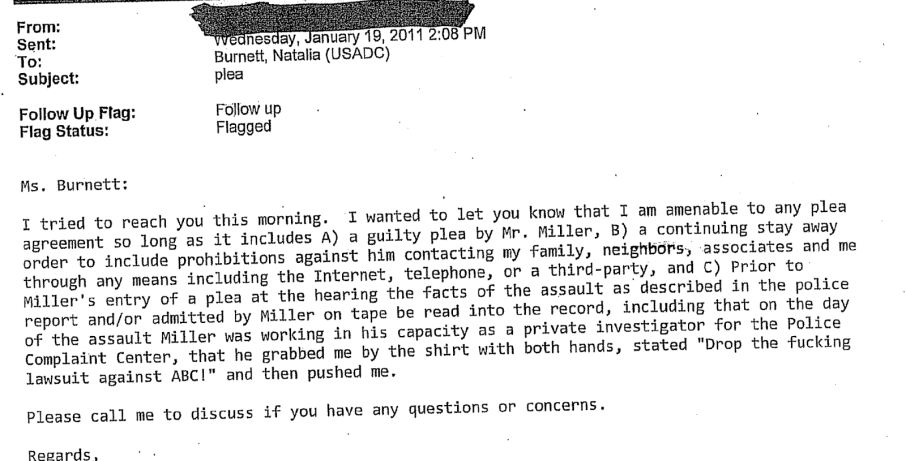
January 19, 2011 email: Slate says any plea should include a factual statement tying Greg Miller's alleged conduct to the ABC lawsuit.
CPO entered against Tyra Ferrell
The later March 2012 OAG filing states that a CPO was entered on April 13, 2011 and ordered removal of web content relating to Slate.
Contempt pressure begins in the local case
The March 2012 filing later says Slate filed a motion to adjudicate criminal contempt on May 10, 2011 after discovering websites containing material about him.
OAG has the ABC bad-faith record before Slate denies PCC employment
The page already documents that OAG received the ABC bad-faith material before the October 14 hearing, where Slate denied ever working for the Police Complaint Center.
Janese Bechtol files to extend the CPO while Slate is in jail
The actual “last filing” is the motion to extend the CPO, stamped filed March 20, 2012. It repeats Slate’s allegations, invokes the contempt finding, and seeks another year of restraint against Ferrell.
Bechtol says Slate is unavailable, then withdraws the extension request
In the later email, Bechtol first says Slate is not available for the April 10 hearing, then tells Ferrell to disregard the continuance request because OAG will withdraw the motion to extend instead.
Slate sues ABC
The federal copyright case becomes the arena in which Slate tries to turn local allegations, witness accusations, and supposed assaults into leverage against ABC.
ABC deposes Slate
The ABC deposition preserves Slate’s testimony about PCC, ABC, his work history, invoices, the 1220 L Street address and related issues that later become central to the bad-faith record.
The Jonathan Johnson / Celina DeNicola episode
ABC says Slate registered with ABC News Video Source in his own name; hours later, an inquiry arrived from his brother’s University of Maryland email account, seeking licensing information for the hidden-camera footage. ABC’s record ties the outgoing message to a University of the District of Columbia IP address, where Slate was attending law school.
Slate accuses ABC lawyer Nathan Siegel of assault
ABC’s later narration describes Slate portraying a brief dispute over a mistakenly produced document as an assault, then escalating it as part of a broader campaign against ABC and its lawyers.
Slate files sanctions material claiming the Miller assault was tied to ABC
Slate’s sanctions exhibit says the DVD contained video files of Miller’s arrest for an assault during which Miller supposedly demanded that Slate “Drop that fucking lawsuit against ABC!”
The story reaches the New York Observer
Kat Stoeffel’s Observer article repeats Slate’s public framing: that Miller allegedly shoved Slate and yelled “Drop that fucking lawsuit against ABC!” before fleeing.
ABC files the bad-faith record
ABC’s bad-faith filing pulls the pieces together: fabricated evidence, brother-identity evidence, witness pressure, and efforts to use local proceedings and accusations to influence the ABC case.
Why this timeline matters
The January 19 Burnett email is the pivot point. It shows Slate trying to make the Miller criminal matter say exactly what he needed for ABC: that Miller acted for PCC and demanded that Slate drop the ABC lawsuit.
Four months later, Slate was using the same theme in federal sanctions papers and in the press. At the same time, the D.C. Attorney General’s office was advancing or preserving the local case against Tyra Ferrell. The graphic is meant to make that overlap impossible to miss.
Meanwhile, Judge Beryl Howell Was Building a Very Different Record
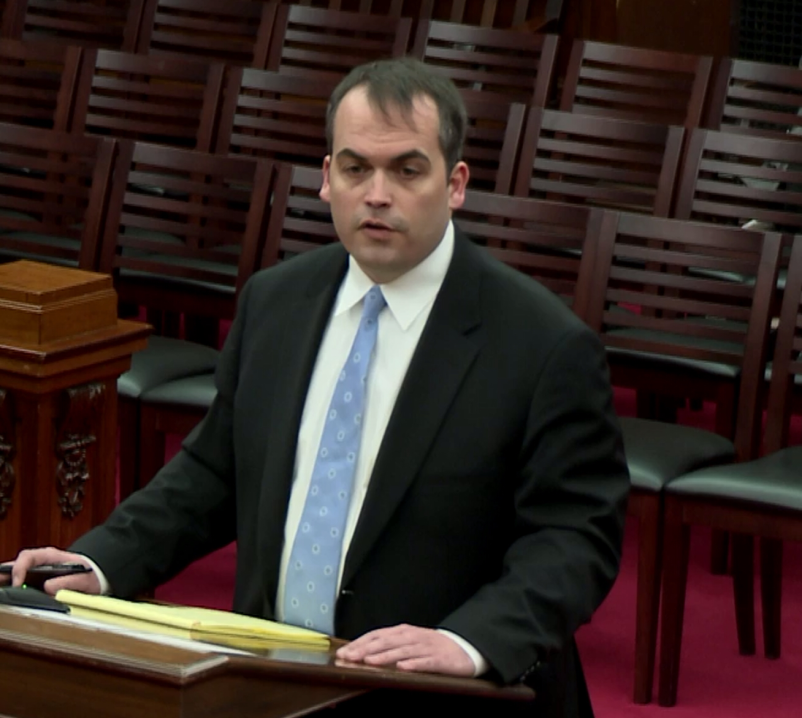
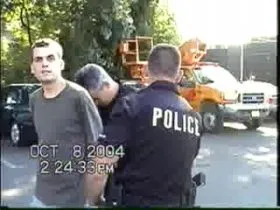
While D.C. prosecutors continued relying on Slate, the federal litigation against ABC was generating a radically different record of his credibility. U.S. District Judge Beryl Howell ultimately found serious bad-faith litigation conduct, including a fabricated letter and testimony the court described as likely perjurious or intentionally misleading.
One of the most striking episodes involved discovery materials delivered to ABC's lawyers. ABC attorney Nathan Siegel stated under oath that Slate personally delivered a box containing court and discovery materials with a powerful odor of excrement and documents stained by a brown substance. Judge Howell later personally observed a visibly soiled envelope with a strong odor of excrement. The court did not determine who caused the contamination.
The importance of that episode is not shock value. It is what the larger federal record said about Slate's methods at the same time another government office was treating his accusations as worthy of extraordinary attention.
Using Jonathan Johnson’s Identity to Manufacture Evidence
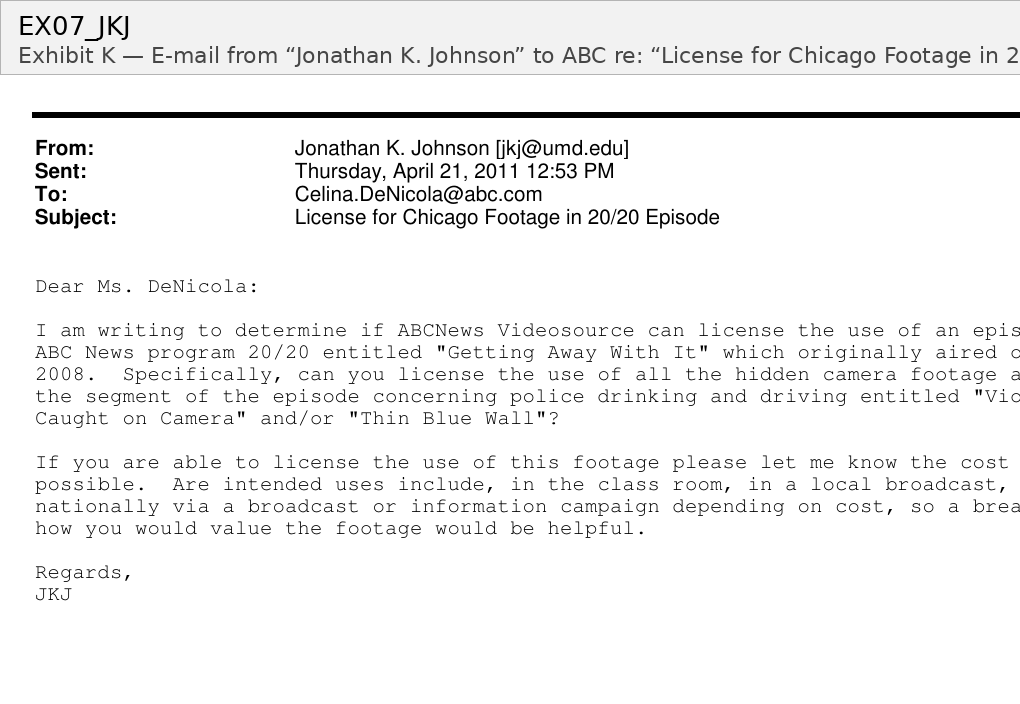
ABC’s September 2011 bad-faith filing describes a much more specific episode than a suspicious IP address. On April 21, 2011, Slate first registered an account with ABC News Video Source in his own name. At 10:14 a.m., ABC employee Celina DeNicola sent him the routine welcome email. A few hours later, an inquiry arrived from “JKJ” using jonathanjohnson@umd.edu — the name and university email of Slate’s younger brother.
The message did not read like a family communication. It posed as an independent customer seeking to license “all the hidden camera footage” in the 20/20 segment for classroom, local-broadcast or national use and asked ABC how the footage would be priced. ABC’s filing says the university address and wording made the inquiry appear to come from a professor or student. DeNicola responded that ABC did not own all of the hidden-camera material in the entire segment — a statement ABC later explained was accurate because much of the program used surveillance and public-record footage from other sources.
The critical point is what happened next. Slate produced only a photograph of part of DeNicola’s response, stripped of the header, date, recipient and the email that prompted it. ABC then recovered the complete chain. Header evidence showed that the outgoing “Jonathan Johnson” message originated from an IP address assigned to the University of the District of Columbia, where Slate was attending law school. The header also showed a read receipt going to the University of Maryland.
ABC argued that Slate had manufactured apparently independent licensing evidence: register with ABC himself, use his brother’s identity/account to pose as an outside customer, obtain an ABC response, and then seek to use the response without disclosing the surrounding context. Slate simultaneously maintained that the native emails were not sent or received by him and were not in his possession or control. The federal court later ordered production of the emails.
The brother-identity evidence did not stand alone. ABC’s filing also cites a September 2007 email in which Slate wrote that he had researched hidden-camera equipment and “ordered both on my brother’s American Express.” ABC identified a $941 Spy Source purchase for a digital recorder and pen camera charged to Jonathan Johnson’s American Express and shipped for Slate’s pickup in Florida.
That history matters because Slate was asked directly about Jonathan Johnson in his January 16, 2023 deposition. He acknowledged Jonathan was his brother, denied ever using Jonathan’s identification, and said he did not recall using a credit card in Jonathan Johnson’s name. Those sworn denials can be compared directly with the earlier ABC record, the equipment-purchase records and the licensing-email evidence.
Courthouse News and McClatchy Reported the Same Federal-Court Record
The excrement-soiled discovery episode was not confined to our reporting. Contemporary legal-news coverage independently reported Judge Beryl Howell’s findings in the ABC case.
Courthouse News Service reported that Howell dismissed Slate’s action after what the court described as a persistent course of bad-faith litigation conduct, including a fabricated letter and discovery documents produced in a soiled envelope carrying a strong odor of excrement.
McClatchy Washington Bureau likewise reported that the suit had been dismissed after a series of problems including soiled documents and allegedly fabricated evidence, and reproduced Howell’s description of the bad-faith conduct.
Beryl Howell / ABC Ruling
The federal ruling and related materials addressing fabrication, misleading testimony, discovery abuse and bad-faith litigation conduct.
Open Beryl Howell RecordSlate's ABC Deposition
The February 25, 2011 deposition preserves Slate's sworn testimony about PCC, ABC, his work history, prior lawsuits and other matters.
Open the DepositionCreating Evidence: The GEICO Investigation
GEICO investigator Theresa Onnen separately described Slate as manufacturing evidence in an insurance claim. The materials in this archive include recordings concerning a prefilled statement, altered evidence, fax and email transmission, and the identification of Geoffrey Johnson as a participant in presenting a statement to another driver.
Theresa Onnen: Creating Evidence
GEICO Full Evidence Segment
Bartlett Identification Segment
Insurance Fraud Evidence
Browser-safe video version of the GEICO evidence. This replaces the older WMA-only link that did not reliably open in modern browsers.
The Greg Miller Assault Story Was Also Turned Into an Insurance Claim
The archive contains a November 9, 2010 claim email sent in the name of Theresa Johnson concerning private investigator Greg Miller and Citizens Investigative Service. The email copied legal@gregslate.com and sought damages arising from the same October 1, 2010 episode, listing assault, battery, trespass, intentional infliction of emotional distress, negligence, false imprisonment, defamation, invasion of privacy, tortious interference, conspiracy and other alleged acts.
The insurer’s November 22 response identifies Claim No. AD12503, acknowledges receipt of the November 9 email, and denies coverage under the policy issued to Citizens Investigative Service. This is significant because the alleged Miller confrontation was not used only as a police or litigation narrative; a monetary insurance claim was also pursued from it.
The page should present the document itself so readers can distinguish the underlying record from my conclusions about who authored or directed the claim.
Read Theresa Johnson / Greg Miller Insurance ClaimThe Prosecutors Had a Choice
Sarah Connell and Janese Bechtol were not merely passive recipients of Slate's claims. They exercised government authority in a case built around those claims. The record shows that warnings about Slate continued to reach the office, including allegations of stalking, fraud, perjury, criminal conduct and later hacking.
My conclusion is that the Domestic Violence Section made a catastrophic allocation of attention: it pursued a dramatic case involving a celebrity while a woman facing an immediate lethal threat struggled without comparable government advocacy.
No internal memorandum needed to say, "Gregory Slate matters more than Alecia Wheeler." Institutions rarely confess priorities in that language. Priorities are visible in what they do.
Tyra Ferrell Confronts Slate — Edited Evidence Excerpt
This shortened excerpt removes unrelated private conversation and preserves the core evidentiary exchange: Tyra challenges the basis for Slate's police-officer story, presses him on what actually connected the explicit image to a Broward Sheriff's deputy, and repeatedly brings him back to the facts while Slate defends the underlying story.
Edited evidentiary excerpt only. The longer private conversation is intentionally not published. This short-render URL is temporary; once the short file is ingested into the Podcast story folder, replace this source with its permanent public Blob URL.
Slate 911 Recording
Bank Break-In Warning
Archived recording associated with warnings made to prosecutor Sarah Connell.
Detective Tucci Call
They Had the ABC Record Before Slate Testified
The October 14, 2011 hearing did not occur in a vacuum. The prosecutors had already been receiving material challenging Slate’s credibility and describing the ABC litigation. On October 7, 2011, one week before the hearing, I sent Janese Bechtol, the Office of the Attorney General, and OAG attorney Emma Clark a YouSendIt delivery for the ABC motion for bad faith. My accompanying message told Bechtol that the pleading was being supplied because we were preparing a motion based on it and specifically asked that the materials be preserved in connection with Sarah Connell.
That matters because at the October 14 hearing Tyra Ferrell confronted Slate about his PCC employment. Slate denied that he had ever worked for the Police Complaint Center. The record therefore presents a direct question about prosecutorial knowledge: the office had been supplied the federal pleading attacking Slate’s credibility before he gave the denial in open court.
October 7, 2011: YouSendIt delivery to Janese Bechtol and OAG — “motion for bad faith.pdf.”
October 14, 2011: Slate answers “No” when asked whether he ever worked for the Police Complaint Center or PoliceAbuse.com.
The Courtroom Ethics Issue
During that hearing the court itself recognized the obvious ethical problem: a lawyer may not knowingly elicit testimony the lawyer believes to be perjurious. The webpage does not claim that the judge separately adjudicated Bechtol or Connell guilty of suborning perjury. The point is narrower and document-based: the prosecutors had been supplied material challenging Slate’s version before the testimony, and the contradiction was placed directly in front of them.
Then Came the March 2012 Filing
By January 5, 2012, Gregory Slate had been arrested and was being held in the D.C. Metropolitan Jail in connection with a stalking warrant. Yet the prosecution involving Tyra Ferrell did not simply stop.
In the litigation we have filed against the District officials, we allege that on March 20, 2012, shortly after Bechtol was told that her conduct would be publicly exposed, she threatened further action and initiated a new proceeding against Ferrell while Slate remained incarcerated. We allege that the filing was retaliatory and was not prompted by a new incident.
The later OAG email trail is important context. On March 29 Bechtol wrote Ferrell that OAG was seeking a continuance because “Mr. Slate is not available”; later that same day she told Ferrell to disregard the request because OAG would withdraw the motion to extend instead.
Those documents do not, by themselves, adjudicate retaliatory intent. They do establish a chronology that readers can evaluate: Slate was in custody, OAG was still attempting to extend proceedings connected to him, and the motion was then withdrawn when his availability became a problem.
They Are Still at the D.C. Office of the Attorney General
This is not merely a dispute about officials who left government years ago. The District of Columbia's 2026 OAG personnel roster still lists Sarah Cynthia Connell and Janese M. Bechtol in the Domestic Violence & Special Victims Section.
The 2026 roster lists Sarah Cynthia Connell as a Trial Attorney in that section and Janese M. Bechtol as a Supervisory Trial Attorney. Both are regular OAG employees in the same public-safety function implicated by the events described on this page.
In my view, that continuity is part of the accountability story. The concern is not simply that poor judgment was exercised in 2011 and 2012; it is that the same public institution retained both attorneys in work affecting domestic-violence victims and other vulnerable people. The records presented here allow readers to decide whether that history should have produced internal correction, discipline, reassignment or public explanation.
Current Status, Not Historical Titles
For accuracy, this page uses the titles shown in the District's 2026 personnel roster. Connell was an Assistant Attorney General during the events discussed earlier on this page; the current roster lists her as Trial Attorney. Bechtol is currently listed as Supervisory Trial Attorney.
What Happened Is an Inversion of the System's Purpose
Alecia Wheeler sought protection from a man threatening to kill her. Gregory Slate was simultaneously the subject of serious complaints from other people, while his credibility was collapsing in other legal and investigative settings. Yet Slate was able to summon government lawyers and government power.
Wheeler could not summon enough of that power to save her life.
That is why this story is not simply about a bad lawyer. It is about government judgment: who is believed, whose case becomes important, whose fear is treated as routine, and what happens when public officials refuse to reconsider after warnings accumulate.
Evidence Archive
This page is designed as a living public archive. Additional court orders, protective-order filings, probation records, arrest records, government emails, photographs and document exhibits can be added as public Blob URLs are confirmed and privacy-sensitive identifiers are redacted.
- Washington Post — Alecia Wheeler Contemporary reporting documenting that Wheeler repeatedly sought protection, filed again the day before her death, and was fatally attacked while walking with her four children.
- OAG warning chronologyDated notice history involving Connell, Bechtol, Irvin Nathan, Gail Stern, Brenda Riddick and MPD personnel.
- Prince George's County / PCC letterSlate's own 2007 statement identifying himself as PCC executive director and director of investigators.
- Slate ABC deposition2011 sworn testimony in which Slate said he did not know what the Police Complaint Center was and did not recall identifying himself as working with PCC.
- PDS hit-and-run filingPublic Defender Service filing describing the Arlington crash, leave requirements, warrant, charges and guilty plea.
- Slate probation reportTo be published in redacted form with Social Security number and unnecessary personal identifiers removed.
- Kamau letter to Slate's fatherContemporaneous 2008 account of Slate's termination from PCC and the breakdown in the relationship.
- Courthouse News / McClatchy coverageIndependent legal-news reporting on Judge Howell’s dismissal, fabricated evidence findings, and excrement-soiled discovery materials.
- OAG YouSendIt receipt — October 7, 2011Documentary proof that Janese Bechtol and OAG were sent the ABC bad-faith filing before the October 14 testimony.
- March 2012 OAG chronologyRecords concerning the proceeding initiated while Slate was incarcerated and Bechtol’s later withdrawal of the extension request.
- Beryl Howell / ABC rulingFederal litigation record concerning fabrication, misleading testimony and bad-faith litigation conduct.
- Hargrove recordingAudio concerning Slate's conduct at property rented by LaDonja Hargrove.
- Mike McCormick recordingsVideo evidence concerning stalking allegations and evidence fabrication.
- GEICO investigationVideo and audio concerning alleged manufacturing and alteration of evidence.
- 911 / police recordingsPrimary-source audio preserved in the public media archive.
History Eventually Caught Up With Gregory Slate
On March 2, 2018, Maryland's highest court disbarred Gregory Allen Slate. The disciplinary case ran directly through the dishonesty exposed in the ABC litigation and his later failure to disclose the substance of those findings during the Maryland bar-admission process.
Alecia Wheeler Did Not Have Seven Years to Wait
Slate was disbarred in 2018. Alecia Wheeler was murdered in 2011. She had already done what the system tells endangered women to do. She asked for help. She went to court. She returned.
The record of what D.C.'s domestic-violence system chose to prioritize during those same weeks belongs to the public. That is why this archive exists.